Arsenic in Arizona Drinking Water: What Phoenix Metro Homeowners Need to Know
Arsenic occurs naturally in Arizona's volcanic geology and reaches both groundwater wells and some municipal supplies across the Phoenix metro. The EPA maximum contaminant level is 10 parts per billion. Phoenix and Scottsdale city water come in well below that limit on current CCR data, but private well owners in Maricopa County face unregulated groundwater where arsenic concentrations can exceed 100 ppb in some aquifer zones.
Arsenic occurs naturally in Arizona's volcanic geology and reaches both well water and some municipal supplies across the Phoenix metro. The EPA maximum contaminant level for arsenic in drinking water is 10 micrograms per liter (10 parts per billion), set in 2001 and enforceable since 2006 (epa.gov/sdwa/arsenic-drinking-water). Phoenix city water tested at 2 ppb arsenic in its 2024 Consumer Confidence Report, well below the federal limit, because Phoenix draws primarily from the Salt and Verde rivers rather than groundwater (phoenix.gov/waterservices). Scottsdale's 2024 CCR shows arsenic not detected in treated distribution water (scottsdaleaz.gov/water). Private well owners face different conditions. USGS National Groundwater Atlas data shows some Arizona groundwater samples exceed 100 ppb arsenic (pubs.usgs.gov). The Arizona Geological Survey identifies arsenic bearing minerals as common across central and southern Arizona geology (azgs.arizona.edu). Arizona law places responsibility for private well water quality entirely on the homeowner (azdeq.gov). Testing your well and installing a certified reverse osmosis system are the most reliable steps you can take.
If you are on a private well or want to verify your tap arsenic level before making any treatment decision, Aqua Wellness provides free on site water testing across Phoenix, Scottsdale, Tempe, Mesa, Chandler, and Ahwatukee. Call Jorge Tejada at (928) 451-1591 to schedule.
Why Arizona has naturally high arsenic in groundwater
Arizona sits atop some of the most mineralized geology in the American West. The state's mountain ranges formed through millions of years of volcanic activity, hydrothermal venting, and tectonic uplift. That process concentrated arsenic bearing minerals throughout central and southern Arizona bedrock. The Arizona Geological Survey documents arsenopyrite and scorodite as common arsenic bearing minerals in the region, both of which dissolve gradually into groundwater as rainwater and snowmelt percolate through fractured volcanic rock (azgs.arizona.edu). Arsenic is odorless, colorless, and tasteless at the concentrations found in drinking water. You cannot detect its presence without a laboratory test. The USGS National Groundwater Atlas documents arsenic in Arizona groundwater samples at concentrations ranging from below 1 ppb to more than 100 ppb in certain aquifer zones (pubs.usgs.gov). The variability depends on which rock formations the aquifer contacts, how deep the well was drilled, the age of the water, and the history of nearby land use. Wells tapping older, deeper confined aquifers in central Arizona mineral belts tend to carry higher arsenic concentrations than shallower wells in valley alluvial deposits. The Phoenix metro spans multiple geologic zones. The Salt River Valley alluvial aquifer tends toward lower arsenic concentrations compared to confined bedrock aquifers in surrounding mountain ranges. Confined zones accessible by deep well drilling in areas east and southeast of Phoenix carry documented arsenic elevations. This geology is the reason Arizona was among the states with the highest number of water utilities that needed to reduce arsenic levels to meet the 2006 EPA compliance deadline. Private well owners in those zones had no compliance mechanism driving action on their behalf.
What Phoenix and Scottsdale city water data actually shows
Phoenix and Scottsdale rely primarily on surface water rather than groundwater, which is why their treated tap water carries very low arsenic concentrations. The City of Phoenix 2024 Consumer Confidence Report documents arsenic at 2 parts per billion in treated distribution water (phoenix.gov/waterservices). The EPA maximum contaminant level is 10 ppb, and Phoenix's measured arsenic level is 80 percent below that limit. Phoenix Water Services draws between 97 and 99 percent of its supply from the Salt River Project and Central Arizona Project, which deliver water from the Salt River, Verde River, and Colorado River reservoir systems. Surface water from these rivers carries far less naturally occurring arsenic than groundwater drawn from deep volcanic aquifer zones. Central Arizona Project water typically carries arsenic below 2 ppb in treated deliveries to member agencies (cap-az.com). CAP water originates at Lake Havasu on the Colorado River and is treated before distribution to utilities across Maricopa County. Scottsdale's 2024 Consumer Confidence Report shows arsenic as not detected in treated water distributed to customers (scottsdaleaz.gov/water). Scottsdale draws heavily from CAP and Salt River surface supplies alongside its own advanced water treatment campus. The practical takeaway for Phoenix and Scottsdale residents on city water is that your municipal arsenic exposure is well below the federal limit based on current CCR data. Utility arsenic levels in surface fed systems are generally stable from year to year because the source water chemistry changes slowly. Verify your utility's current annual CCR for the most recent figures. Phoenix publishes its CCR each July at phoenix.gov/waterservices, and Scottsdale publishes at scottsdaleaz.gov/water.
Private wells in Maricopa County: the bigger arsenic risk
Private well owners in Maricopa County are not protected by municipal treatment systems. Arizona law assigns full responsibility for private well water quality to the well owner. The Arizona Department of Environmental Quality states clearly that homeowners with private wells are responsible for testing and treating their own water supply (azdeq.gov/environ/water/dw/private_wells.html). ADEQ does not set enforceable limits for private wells and does not automatically notify well owners when nearby contamination is detected through aquifer monitoring programs. Maricopa County has tens of thousands of active private wells, concentrated in areas outside city water service territories including large portions of the far East Valley, the west Valley beyond the urban grid, and rural tracts surrounding the metro core. These areas draw from alluvial and bedrock aquifers that can carry arsenic at concentrations well above the 10 ppb MCL depending on the depth and geologic zone of the well. The USGS National Groundwater Atlas confirms that some Arizona groundwater samples exceed 100 ppb arsenic, which is ten times the federal drinking water limit (pubs.usgs.gov). At those concentrations, long term exposure carries documented cancer and cardiovascular risks per EPA health documentation at epa.gov/sdwa/arsenic-drinking-water. The only way to know your well's arsenic level is to test it. Testing is relatively inexpensive. An ADEQ-certified laboratory arsenic test for a single household well typically costs between $20 and $50, though pricing varies by lab and region. Full panel tests covering arsenic alongside bacteria, nitrates, hardness, and other common groundwater concerns typically cost $100 to $250. ADEQ maintains a list of certified drinking water laboratories at azdeq.gov, searchable by contaminant and county.
Aqua Wellness serves private well properties across the Phoenix metro, including East Valley communities where well water is common. Call (928) 451-1591 or schedule a free water test online. Jorge Tejada and his team will test your water at your tap, share results in person, and recommend a treatment system sized to your specific arsenic concentration and full water chemistry.
Health effects of long term arsenic exposure
Arsenic at concentrations found in drinking water does not cause immediate illness. The documented risks come from chronic exposure over years or decades of daily consumption. The International Agency for Research on Cancer classifies arsenic as a Group 1 carcinogen, meaning there is sufficient evidence from human populations to establish that arsenic causes cancer (iarc.who.int). The cancers most associated with long term arsenic ingestion through drinking water are bladder cancer, lung cancer, and skin cancer. Research from populations with naturally high arsenic well water, particularly in Bangladesh, Chile, and Taiwan, established the dose response relationships that informed WHO and EPA guideline setting worldwide. The World Health Organization's guideline for arsenic in drinking water is 10 micrograms per liter, the same figure as the EPA MCL (who.int). The WHO notes that this guideline reflects achievable treatment performance rather than a no-risk threshold. There is no confirmed safe level of arsenic exposure in drinking water, and the guideline is set at the lowest practically measurable and achievable concentration given current treatment technology. Beyond cancer, long term arsenic exposure has been associated with cardiovascular disease, skin changes including hyperpigmentation and keratosis, peripheral neuropathy, and adverse reproductive outcomes, according to EPA health effects documentation at epa.gov/sdwa/arsenic-drinking-water. Children may face greater sensitivity to arsenic effects than adults on a body weight basis. Households with young children on private well water with unknown arsenic levels should treat testing as a priority. Arsenic exposure during development carries different risk considerations than adult exposure, and no regulatory agency has set a separate child protective standard to guide individual well owners.
How to test your water for arsenic in Arizona
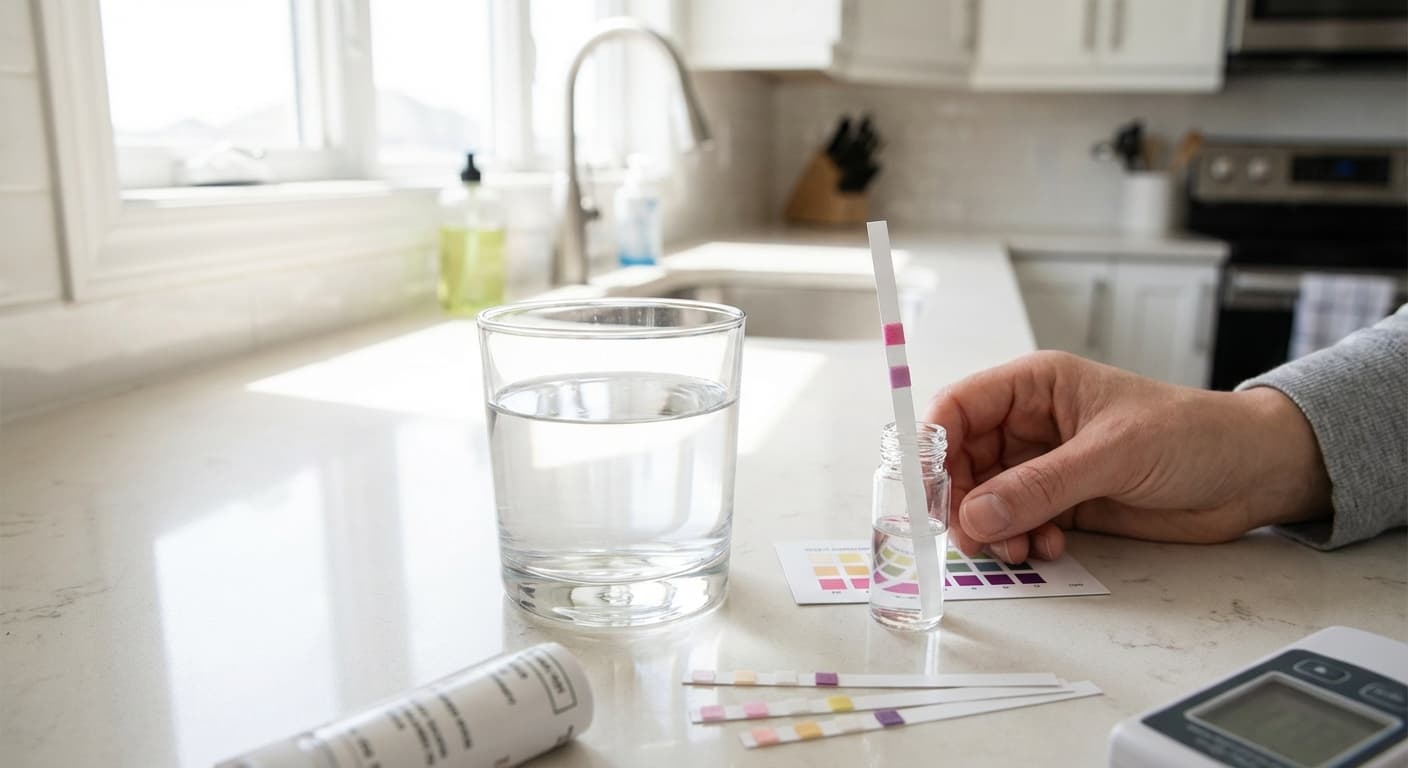
An arsenic water test is straightforward. You collect a water sample in a labeled bottle supplied by the certified laboratory, mail it back following the lab's instructions, and receive numeric results in parts per billion within a few business days. ADEQ certifies laboratories to analyze drinking water for arsenic in Arizona. A current list of certified labs is at azdeq.gov. When selecting a lab, verify it holds active ADEQ certification specifically for arsenic in drinking water, not only for general water quality parameters. The lab will specify the collection protocol for your situation. For arsenic testing on a private well, labs typically request a first draw sample, meaning water collected from a tap that has not been run for six or more hours overnight, to capture water that sat in contact with well casing, pump, and household plumbing. An ADEQ-certified lab arsenic test for a single household well typically costs $20 to $50 depending on the laboratory and turnaround time selected. A comprehensive panel covering arsenic alongside bacteria, nitrates, hardness, pH, and other common groundwater contaminants typically costs $100 to $250. Many ADEQ-certified labs offer mail in sample kits that ship to your door, making the process manageable without traveling to a lab. For Phoenix metro homeowners who prefer an on site test and a face to face explanation of results, Aqua Wellness brings testing equipment directly to your tap and walks through the findings with you in person before discussing any treatment option. There is no charge for the initial water test. Frequency guidance for private well owners: test for arsenic when you first move in, after any significant nearby construction or grading activity, and then every one to three years as routine maintenance. Arizona groundwater arsenic concentrations can shift over time as aquifer conditions, pumping patterns, and annual recharge volumes change. A baseline test from several years ago does not confirm your current level is unchanged.
What actually removes arsenic from drinking water
Not all water filters remove arsenic. This distinction matters because many homeowners assume a standard carbon pitcher or faucet filter handles all contaminants. It does not. Reverse osmosis systems certified to NSF/ANSI Standard 58 can reduce arsenic by 95 percent or more, according to NSF International certification data (nsf.org/certified-products-systems). An NSF/ANSI Standard 58 certified RO system uses a semipermeable membrane that physically rejects arsenic ions along with other dissolved solids, including nitrates, fluoride, and PFAS compounds. This makes reverse osmosis the most effective residential treatment option for arsenic at the kitchen tap. Standard granular activated carbon filters reduce chlorine, chloramines, and volatile organic compounds. They do not reliably reduce inorganic arsenic. A carbon pitcher filter on a well carrying 40 ppb arsenic will not address the problem at all. Water softeners exchange calcium and magnesium for sodium and have no mechanism for removing arsenic. A softener alone does not protect against arsenic regardless of source water concentration. For well water with arsenic at or above the 10 ppb MCL, the standard residential approach is an NSF/ANSI Standard 58 certified RO system at the kitchen tap covering drinking and cooking water. For very high arsenic concentrations above 50 ppb, a whole home arsenic treatment system using oxidizing filter media specifically rated for arsenic may be appropriate upstream of the RO unit to handle the bulk of the load. When evaluating any filter or system marketed for arsenic reduction, confirm the product's NSF/ANSI 58 certification at nsf.org before purchasing. The NSF database is the authoritative source. Certification claims on product packaging and retail websites vary in accuracy, and the formal certification lookup at nsf.org is the only reliable check.
What Phoenix metro homeowners should do right now
Here is a concrete action plan based on your water source. If you are on Phoenix or Scottsdale city water, your current CCR data shows arsenic well below the federal limit. Review your annual CCR at phoenix.gov/waterservices or scottsdaleaz.gov/water to confirm, and check again each year when your utility publishes a new report. If you want additional protection for drinking and cooking water, an NSF/ANSI Standard 58 certified reverse osmosis system at the kitchen tap is a practical option. The same system also reduces PFAS, fluoride, nitrates, and total dissolved solids, making it a comprehensive point of use solution for tap water quality. If you are on a private well in Maricopa County, test your water for arsenic now if you have not done so within the last two years. Use an ADEQ-certified laboratory and request results in parts per billion. If your arsenic comes back at or above 10 ppb, install a certified RO system at the kitchen tap at minimum. If your arsenic exceeds 50 ppb, discuss a whole home treatment approach with a water treatment professional before selecting equipment. If you are purchasing a home with a private well, request a current water test from the seller as part of your due diligence process. Arizona does not require sellers to disclose private well water quality test results, so you must request the test independently. Jorge Tejada and the Aqua Wellness team serve Phoenix, Scottsdale, Tempe, Mesa, Chandler, and Ahwatukee. We are WQA Certified and BBB A+ rated. Every consultation starts with a free water test at your tap so you know exactly what your water contains before we discuss any treatment option. Call us at (928) 451-1591 or schedule online. We will come to you, test your water, and give you straight answers about what it contains and what, if anything, to do about it.
Frequently asked questions
- What is the EPA limit for arsenic in drinking water?
- The EPA Maximum Contaminant Level for arsenic in drinking water is 10 micrograms per liter (10 parts per billion). The EPA finalized this standard in 2001 and it took effect for water utilities in January 2006. Full rule and health effects documentation are at epa.gov/sdwa/arsenic-drinking-water.
- Does Phoenix tap water have arsenic?
- Yes, but at a very low level. The City of Phoenix 2024 Consumer Confidence Report measured arsenic at 2 parts per billion in treated distribution water, which is 80 percent below the federal limit of 10 ppb. Phoenix draws most of its supply from Salt River and Verde River surface reservoirs, which carry less naturally occurring arsenic than deep groundwater. See current data at phoenix.gov/waterservices.
- Are private wells in Maricopa County at risk for arsenic?
- Yes, potentially. Private wells tap unregulated groundwater that receives no municipal treatment. Arizona law places full responsibility for well water quality on the homeowner. USGS National Groundwater Atlas data shows some Arizona groundwater exceeds 100 ppb arsenic. Testing is the only way to know your actual level. ADEQ maintains a certified lab list at azdeq.gov.
- What water filter removes arsenic from tap water?
- Reverse osmosis systems certified to NSF/ANSI Standard 58 can reduce arsenic by 95 percent or more, according to NSF International certification data at nsf.org. Standard carbon block or pitcher filters do not reliably remove inorganic arsenic. Water softeners have no effect on arsenic. Confirm NSF/ANSI 58 certification directly at nsf.org before purchasing any system.
- Is arsenic in drinking water dangerous?
- Long term arsenic exposure through drinking water is classified by the International Agency for Research on Cancer as a Group 1 carcinogen, meaning sufficient evidence from human populations confirms arsenic causes cancer. The cancers most associated with chronic arsenic ingestion are bladder, lung, and skin cancers. Both the WHO and EPA set their guideline at 10 micrograms per liter. Full documentation at iarc.who.int and who.int.
- How often should I test my private well for arsenic?
- Test when you first move in as a baseline, after any significant nearby construction or industrial activity, and then every one to three years as routine maintenance. Arizona groundwater arsenic concentrations can shift with aquifer recharge and pumping patterns over time. A single test from several years ago does not confirm your current level. ADEQ-certified lab listings are at azdeq.gov.